Here's one. I used to hate facial hair. Then it grew on me.
You either groaned or you didn't, but either way that joke only works because it hits a very specific register. A touch too clever and it's a pun nobody groans at. A touch too rude and it's a completely different kind of joke. The dad joke lives in a narrow band, and landing in that band every single time is surprisingly hard.
Which is exactly why I built an app to do it.
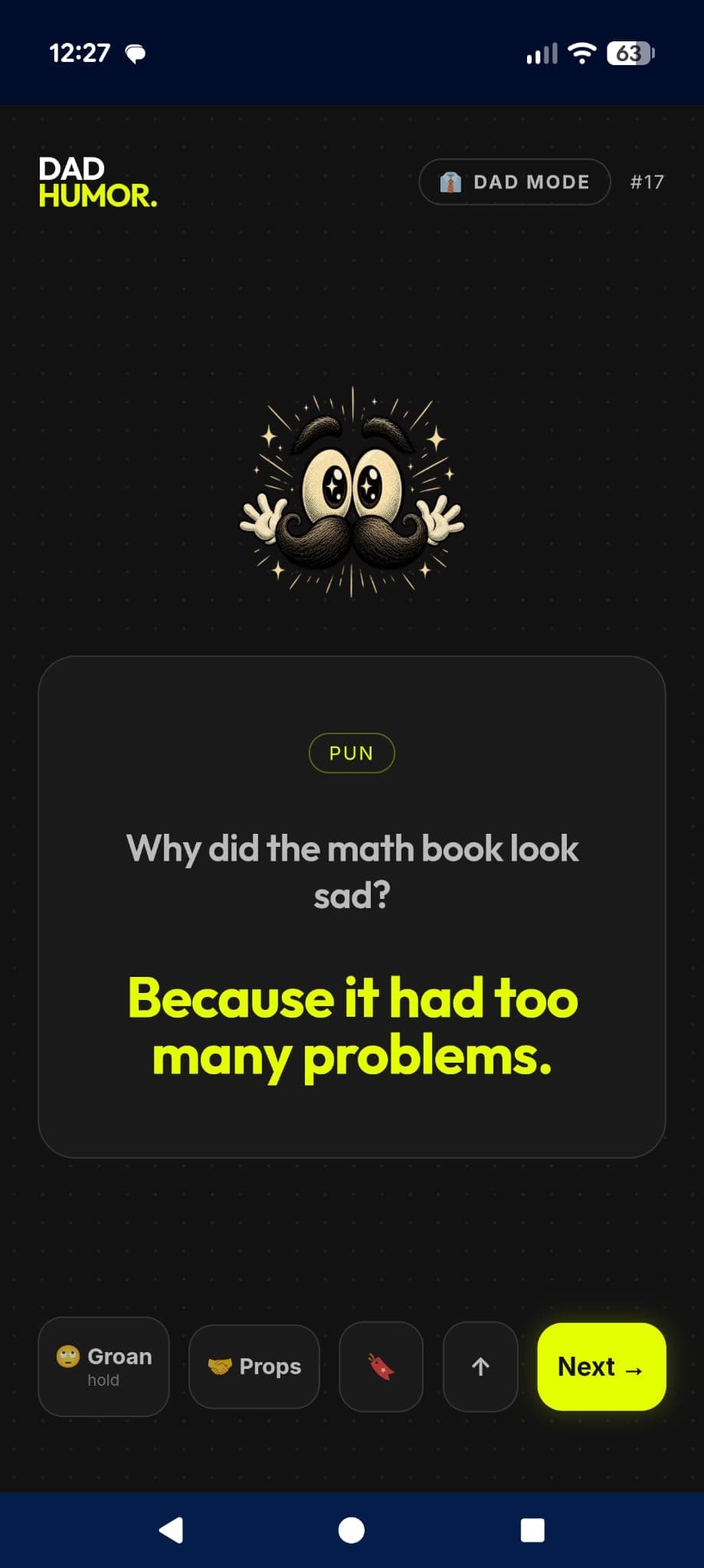
Dad Humor (US spelling, and that's a rule I'll come back to) is a small web app that generates dad jokes on demand. It's live, it's deliberately daft, and it's also the cleanest demonstration I've got of the least daft thing I do for clients: building a voice an AI can hit reliably.
A dad joke is a brutal voice test
Most "brand voice" is mush. "Professional but approachable." "Friendly and authoritative." Phrases that describe almost any business and instruct almost nothing.
A dad joke won't let you get away with that. The register is precise and unforgiving. Too clever, miss. Too crude, miss. Too try-hard, miss. If you can document a voice tightly enough that an AI produces a genuine dad joke on demand - the groan, the inevitability, the faint smugness - then you've actually pinned a voice down. Most people never get close, because they describe a vibe and hope.
So I treated a pile of dad jokes like a serious voice brief.
What I actually documented
A register system, for a start. The default register is PG-with-attitude: cheeky, groan-worthy, never mean, safe at the family table. Then there's an opt-in "Spicy" register for people who want a bit more bite - same engine, safety catch off, still no actual filth, just more willing to go near the knuckle.
Then the rules that stop it drifting:
- Slang gets flagged inline for sign-off, so nothing modern slips in unchecked and dates the whole brand overnight, or says something I didn't intend.
- US spelling for the brand name (Dad Humor, no "u"), UK English everywhere else - which is why it's "humour" in this article and "Humor" on the logo. A small rule, written down once, then applied forever without me thinking about it again.
- A clear line on what the brand never does.
None of that is really about jokes. It's voice infrastructure - the same documented layer I build as the first stage of an AI Blueprint. The jokes just make it obvious the moment it's wrong.
The silly bit is the point
Here's the move most people miss. The sillier the subject, the harder the voice test - and the more convincing it is when it holds.
Show someone an AI writing competent copy for a consultancy and they nod politely. It's hard to tell whether the voice is right or just inoffensive. Show them an AI reliably landing a specific flavour of dad joke, then switching cleanly into a different register on request, and they can see the machinery working. The constraint is visible.
And it transfers exactly. The method that pins down "PG-with-attitude dad joke, opt-in Spicy, no dated slang" is the same method that pins down "plain-speaking pensions adviser, confident but never salesy, careful on compliance, allergic to jargon." Different words on the page. Identical work underneath: define the register, write the rules, document the edge cases, make it repeatable. If it holds for dad jokes, it holds for a pensions firm. The serious version is honestly the easier one.
The honest bit
A voice document isn't three adjectives and a colour swatch. The value is in the specifics and the edge cases - the words you'd never use, what happens at the boundaries, the judgement calls that aren't obvious. That's the actual work, and it's why "just tell the AI to sound like us" doesn't get you there. The AI will cheerfully sound like a generic version of you, forever, until someone does the defining.
I did it for dad jokes because it amused me. The thing underneath isn't a joke at all.
The takeaway
If your AI output sounds like everyone else's, this is usually the layer that's missing - not a better model, but a documented voice the AI can actually reach. Building that is the first thing I do in an AI Blueprint, and it's the difference between AI that sounds like a robot and AI that sounds like you.
Go and break the app if you fancy it - Dad Humor is here. Then, if you want the serious version of the same thing for your business, let's talk.
I'll see myself out. The jokes won't.
See where your AI setup actually stands
The AI Scorecard - 12 questions, about 3 minutes, an honest verdict and the one thing to fix next. Including "not yet" if that's the right answer.